
Susun Kelapa
| Susun Kelapa | |
| Scientific Name | Tabernaemontana corymbosa |
| Synonym | Pagiantha peninsularis var. brevituba, Ervatamia corymbosa, Pagiantha peninsularis, Flore Pleno, East Indian Rosebay |
| Family | Apocynaceae |
| Order | Gentianales |
 |
{slider=Common Name}
Flower of Love (English),
{/slider}
{slider=Description}
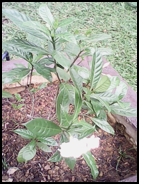
Dichotomously branched from low down; trunk terete, bark with much white latex, wood rather soft Leaves, 3-25 cm long, with milky sap opposite, those of a pair equal or subequal, leaf blade ovate to obovate, base equal or unequal-sided, entire or sometimes sinuate or undulate,. Petiole 0.3-2 cm;, apex acuminate. The flowers are 5-merous, 1-5 cm in diameter, white in colour and fragrant. Flower buds with a globose head, rounded at apex. The tube often greenish 1.8-3.1 cm;, the throat often pale yellow, the tube mostly at least twice as long as the calyx, twisted or not, lobes overlapping to the left and folded inwards; stamens included or less often exserted; ovary superior, composed of 2 carpels variably connate at the base; pistil head not coherent with the anthers. Stamens inserted above middle of corolla tube. Fruit composed of two mericarps variably united at the base, subglobose to pod-like, many-seeded. (Chua et al., 2001)
{/slider}
{slider=Geographical Distribution}
It is found in Brunei, China, Indonesia, Laos, Malaysia, Myanmar, Singapore, Thailand, and Vietnam
{/slider}
{slider=Plant Material of Interest}
This plant's best feature is its delightful fragrance. Intended as an ornamental or decorative purposes are occasionally sold in local nurseries. The leavescan be trimmed to give a desired shape.
{/slider}
{slider=Traditional Uses}
The most common use of Tabernaemontana in Malaysia is for the treatment of ulcerations of the nose using pulped roots, or less commonly leaves, are simply drawn into the nostrils. Leaves, bark or latex of several species are an ingredient of mixtures used as dart poison. In Thailand, the roots have been employed in folk medicine, for the treatment of inflammations and fever.In China, the plant is applied to boils, swelling, sparains and bruises (Chua et al., 2001)
{/slider}
{slider=Pharmacology}
ANTI MICROBIAL The crude alkaloid extracts of T. corymbosa were tested against four bacterial and two fungi species by using disc diffusion method. It is found that this plant act as microbial agent and inhibit the growth of Baciluus cereus, Pseudomonas aeruginosa, Staphylococcus, Candida albicans, Esscherichia coli. The zones of inhibiton against the tested bacteria were found in the range of 7.00 to 14.75 mm, along with their MIC and MBC/MFC values ranging from 0.37-1.11 mg/mL and 3.33-10.00 mg/mL (Muhammad, T. et al., 2011)
ANTI CANCER ACTIVITY Bistabercarpamine A (1), alkaloid compound found in T.corymbosa exhibited moderate cell growth inhibitory activity against HepG-2 cells with IC50 of 38.14 ± 1.1 μM (Ke Ma et al., 2014)
{/slider}
{slider=Chemical Constituents}
The most important group are the alkaloids. Bistabercarpamines A (1) and B (2), vobasinyl-chippiine-type bisindole alkaloid from the leaves of Tabernaemontana corymbosa. The structures were elucidated on the basis of spectroscopic data, and the absolute configurations of these isolates were determined by CD excition chirality method. Four tetracyclic oxindole alkaloids, 7(R)- and 7(S)-geissoschizol oxindole (1 and 2), 7(R),16(R)- and 7(S),16(R)–19(E)-isositsirikine oxindole (3 and 4), in addition to a taberpsychine derivative, N(4)-demethyltaberpsychine (5), were isolated and the structures were established using NMR and MS analysis (Kuan et al., 2009). Conodiparine ABD (vobasine type) and ervatamine also can be found in T. Corymbosa (Chua et al., 2001)
{/slider}
{slider=Toxicity Studies}
The cytotoxic activity was studied in vitro using human non-small lung carcinoma (A549) and human cervical carcinoma (C33A). The cells were exposed to three crude alkaloid extracts of T. corymbosa. The alkaloids were extracted from stembarks of T. corymbosa using maceration and acid-base extractions methods The cytotoxic effects of these crude alkaloid extract were evaluated by MTT assay. Cytotoxicity study showed that crude B alkaloids exhibited cytotoxic effect against A549 an C33A cancer cell, giving an IC50 as low as 7.81ng/mL and 3.91 ng/mL, respectively. (Muhammad, T. et al., 2011)
{/slider}
{slider=References}
1. Chua, L.S.L & Horsten, S.F.A.J., (2001). Tabernaemontana L. Record from Proseabase. van Valkenburg, J.L.C.H. and Bunyapraphatsara, N. (Editors). PROSEA (Plant Resources of South-East Asia) Foundation, Bogor, Indonesia.
2. Ke Ma, Jun-Song Wang, Jun Luo, Ming-Hua Yang, He-Quan Yao, Hong-Bin Sun, Ling-Yi Kong (2014) State Key Laboratory of Natural Medicines, Department of Natural Medicinal Chemistry, China Pharmaceutical University, 24 Tong Jia Xiang, Nanjing 210009, People’s Republic of China Tetrahedron Letters . 55(1):101–104.
3. Muhammad Taher, Nur ‘Izzati binti Mansor, Deny Susanti (2011). Cytotoxic and and Antimirobial Activities of Alkaloids from Tabernaemontana corymbosa
4. Kuan-Hon Lim, Kooi-Mow Sim, Guan-Huat Tan, Toh-Seok Kam (2009). Four tetracyclic oxindole alkaloids and a taberpsychine derivative from a Malayan Tabernaemontana. Phytochemistry, Volume 70, Issue 9, June 2009, Pages 1182–1186.
{/slider}
- Last updated on .
- Hits: 1949