
Ruku-ruku
| Ruku-ruku | |
| Scientific Name |
Ocimum sanctum |
| Synonyms | Ocimum tenuiflorum |
| Family | Limiaceae |
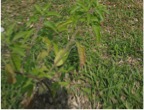 |
{slider=Common Name}
Holy basil, tulasi
{/slider}
{slider=Chemical Content}
Esssential oil of rhizome contained: sabinene, terpinen-4-ol & DMPBD ((E)-1(3,4-dimethylphenyl)butadiene). The rhizome contained curcuminoids such as cassumunins A, B, C. Phenylbutenoid, Zerumbone.
{/slider}
{slider=Geographical Distribution}
Native to India and Southeast Asia
{/slider}
{slider=General Appearences}
Root:Thin, wiry, branched, hairy, soft, greenish brown externally & Pale blackish internally
Stem: Erect, herbaceous, woody, branched, hairy, subquabrangular, externally greenish, internally cream
coloured, fractured, fibrous, in barks & short in xylem, odour - faintly aromatic.
Leaf:Leaves (Green type of O. sanctum), exstipulate, opposite, petiolate.
Flower : Crimson coloured, small inclose whorls, bracts about 3 mm long and broad,
Fruit : A group of 4 nut lets, each with one seed, enclosed in and enlarged, membranous, veined calyx, odour-aromatic, taste pungent.
Seed:Rounded to oval brown mucilaginous when soaked in water; 0.1 cm long, slightly notched at the base, no odour, taste-pungent, slightly mucilaginous (Joshi V.R. et al 2012).
It is propagated by seeds.
{/slider}
{slider=Chemical Content}
Essential oil comprised eugenol(46.2%), (E)-caryophyllene (27.6%) and β-elemene (16.3%)
{/slider}
{slider=Traditional Uses}
The herb used in Ayuveda medicine for cough, asthma, fever and common cold
{/slider}
{slider=Pharmacology}
Anti-diabetic
Ethanolic extract of O. sanctum has significant and sustained oral hypoglycemic activity comparable with the hypoglycaemic of glibenclamide, a sulfonyurea (Rao S. A., et al 2003).
Anti-stress:
Compound ocimumosides A from leaves of O. sanctum displayed promising anti-stress effects by normalizing hyperglycemia, plasma corticosterone, plasma creatine kinase, and adrenal hypertrophy (Gupta P. et al 2007).
Anti inflammatory Activities:
Anti-inflammatory activity of essential oil extract of Ocimum sanctum L. leaf (Eugenol) was studied in Wistar rats by using carrageenan induced Hind paw edema method. The extract was administred 100 mg/kg body weight per intraperitoneally (i.p.) and the standard paracetamol was also administered 5 mg/kg body weight per intraperitoneally (i.p.). The extracted Eugenol and paracetamol exhibited significant (p< 0.05%) activity when compare with carrageenan control (Thakur K. & K.S. Pitre, 2009).
Immunomodulatory
Antioxidant activity of polar methanolic extract of aerial parts of Ocimum sanctum using multiple screens was studied. Various concentrations of the standardized extract were examined for the free radical scavenging activity, superoxide radical scavenging potential and effect on nitric oxide production in RAW 264.7 mouse monocytes cell line. The results indicated that the O. sanctum
extract has strong antioxidant activity. These results suggest that the antioxidant activity of O. sanctum may be partly responsible for its reported immunomodulatory and anti-inflammatory effects (Jadhav H.R. et al ).
Male contraceptive agent:
Fresh leaves of Ocimum sanctum (OS) were used to study its effect on male reproductive function (sperm count and reproductive hormones) in male albino rabbits. Animals in the test group received supplementation of 2 g of fresh leaves of OS per rabbit for 30 days, while the control group was maintained on normal diet for the same duration. Sperm count and hormonal estimation [testosterone, follicle stimulating hormone (FSH), and luteinizing hormone (LH)] were done in serum samples of both groups and compared. A significant decrease was noted in the sperm count in test group rabbits. Serum testosterone levels showed marked increase while FSH and LH levels were significantly reduced in OS-treated rabbits. The results suggest the potential use of OS as an effective male contraceptive agent (Sethi J., M. et al., 2010).
{/slider}
{slider=Toxicity}
Extract of Ocimum sanctum is not genotoxic in bacterial reverse mutation, chromosomal aberration and micronuclease tests. In an acute oral toxicity test, rats were treated with 5g/kg of the extracts and observed for signs of toxicity for 14 days and the results did not show any treatment related toxic effects to Wistar rats (Chandrasekaran C.V et al. 2013).
{/slider}
{slider=Reference}
Chandrasekaran CV., HS Srikanth, MS Anand, J. Joshua Allan, M.M Hipolith Viji, A. Amit (2013). Evaluation of the mutagenic potential and acute oral toxicity of standardized extract of Ocimum sanctum. Human Exp Toxicol Vol 32 (9) Pg 992-1004. http://het.sagepub.com.
Gupta P., D.K. Yadav, K.B. Siripurapu, G. Palit & R. Maurya (2007). Constituents of Ocimum canctum with Antistress Activity. J. Nat Prod. 70. Pg 1410-1416.
Joshi V.R., C.S. Mehta, B.J. Pattagiri & P.K. Prajapati (2012). Pharmacognostic and scientific evaluation of the plant- Tulsi (Ocimum sanctum). International Journal of Green and Herbal Chemistry Vol 1. No 1 Pg 75-90.
Rao S. A., Vijay Y. Deepthi T., Sri lakshmi Ch., V. Rani, S. Rani, B. Reddy Y., R. Swaroop P., Sai Laxmi V., Nikhil Chakravarthy K., Arun P. (2003). Antidiabetic effect of ethanolic extract of leaves of Ocimum sanctum in alloxan induced diabetic in rats. International Journal of Basic & Clinical Pharmacology . http://www.scopemed.org/fulltext.
Thakur K. & K.S. Pitre (2009). Anti-inflammatory activity of Extracted Eugenl from Ocimum sanctum L. Leaves. Rasayan J. Chem Vol 2 (2) Pg 472-474.
Jadhav H.R., A. Singh and K.K. Bhutani .Rationale for Immunomodulatory and Anti inflammatory Effects of Ocimum sanctum: Radical Scavenging Potential and Effect on Nitric Oxide Production. http://wwwlib.teiep.gr/images/stories/acta/Acta%20678/678_22.pdf.
Sethi J., M. Yadav, S. Sood, K. Dahiya & V. Singh (2010). Effects of tulsi (Ocimum Sanctum Linn.) on sperm count and reproductive hormones in male albino rabbits. International Journal of Ayurveda Research. 1(4) Pg 208-210.
{/slider}
- Last updated on .
- Hits: 2097